
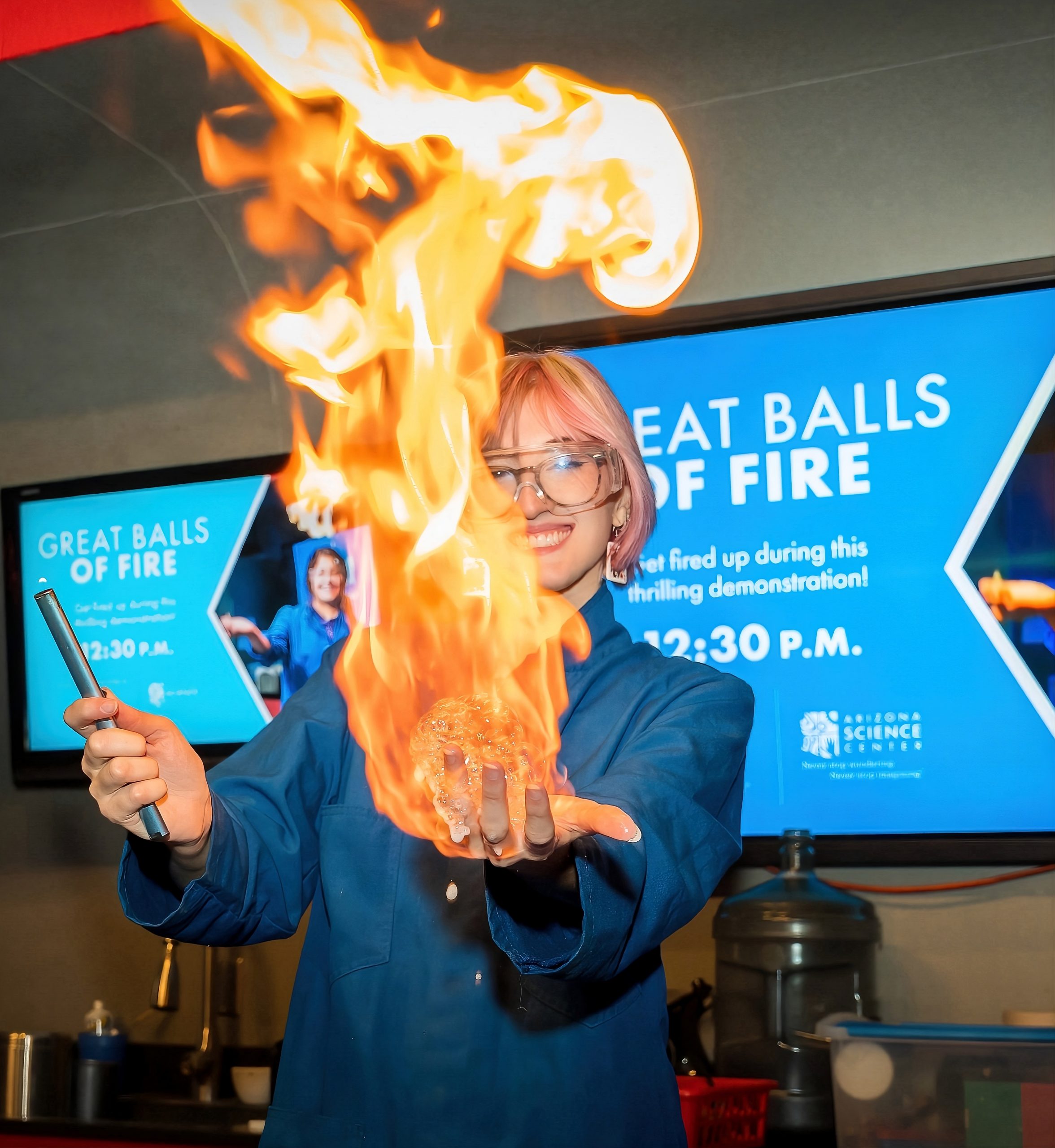
Hailey Nelson
Hailey Nelson
Hailey Nelson is a current Astrophysics PhD student at Arizona State University’s School of Earth and Space Exploration. Her research uses stellar composition to predict the probability that a star hosts a habitable, Earth-like exoplanet and to inform future biosignature detection methods, such as the Habitable Worlds Observatory. She graduated with a triple major from Arizona State University and Barrett The Honors College in Earth and Space Exploration (Astrophysics) (BS), Chemistry (BS), and French (BA). During her undergraduate studies, she created an informal education project to make engaging education more accessible to the public—a project she is continuing and evolving during her PhD studies to have a broader impact and reach new audiences. This involves studying the impact of different inquiry-based teaching methods on students’ desire to do science.
She has been heavily involved in science communication for much of her life. She has worked as a Science Communicator at the Arizona Science Center since 2022, performing demonstrations and facilitating exhibits and activities for hundreds to thousands of guests daily. She also works for NASA’s Mission to Psyche, where she designs exhibits and events and manages an archive of over 500 art pieces inspired by the mission. As of 2025, she is also a co-investigator for the School of Earth and Space Exploration (SESE)’s Prison Education Program, where she works collaboratively to develop and teach earth and space science curricula at a juvenile detention facility. Additionally, she co-founded the Open House Club at SESE to manage and facilitate the school’s annual Open House event, where various groups across share their science with the public, and the SESE Outreach Club, which focuses on connecting students and faculty with outreach opportunities in the community.
Hailey is also an Analog Astronaut with Southeast Analog, where she does astronaut training on Earth and runs a simulated space mission to inform future NASA missions. As the Crew Scientist, her primary role is to coordinate, document, and execute selected research projects while in the analog habitat. Through her training, she gained important skills through virtual and in-person training across a wide range of relevant fields, including medicine, psychology, aeronautics, astronautics, extreme environments, scuba diving, and more. Her mission took place in August 2026 at the Titan Ranch missile silo, where she, her crew, and their mission control team simulated a Mars mission for 10 days in complete isolation.



About Post Author
